· essay
An Esoteric Reading of the Ars Nova
EuroMAC10 — Deconstructing Music Theory [A]. Chairs: Ivan Moshchuk and David Malvinni. Friday, September 24, 2021, 9:00–12:00.
Prior to Aristotelian revival over the twelfth and thirteenth centuries, Western culture was wedded to the ideology of the church. Music submitted to this ideology by conforming to discrete disciplines of speculativa and practica — music theory and musical practice, respectively. The emergence of the ars nova in the High Middle Ages saw a commingling not only of sacred and secular musical content within the burgeoning motet genre but also a concatenation of speculativa and practica — a radical reconception of the ends of theory itself.
A principal development of this new musical practice was a notation system that permitted greater rhythmic and metrical freedom than was strictly allowable under Christian numerology. While we traditionally view the ars nova’s notational advances as practical achievements, I propose that the movement effectively emerged and operated as an esoteric knowledge system — outside both the ars vetus of the church and the Aristotelian trends taking hold within the university — based on a conceptual blending that united speculativa and practica and emancipated musical knowledge from its deployment toward traditional theo-philosophical ends. Insofar as a symbolic comingling — of sensible/non-sensible, theoretical and practical — is a feature shared with other medieval knowledge systems, comparison with a contemporaneous work in the field of magic suggests a deeper significance of the ars nova’s musical technology.
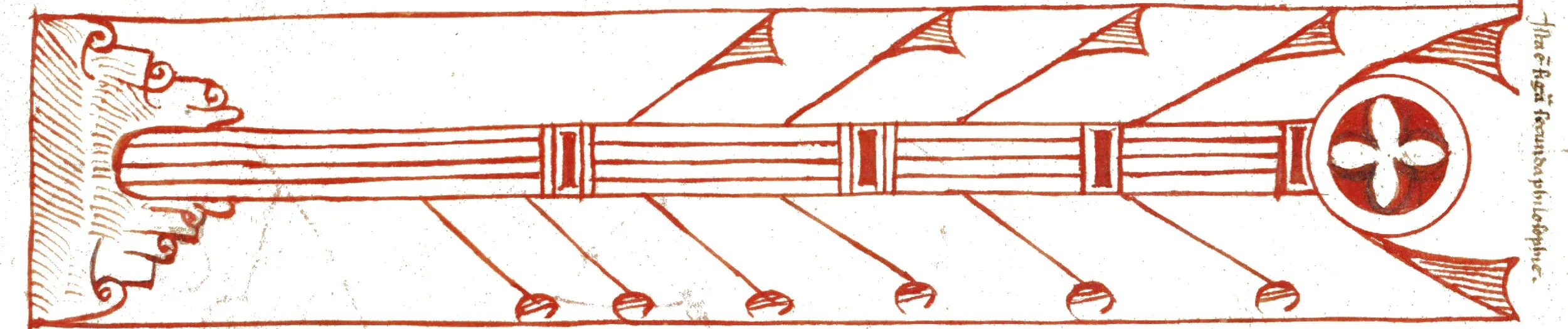
Magical writing during the Middle Ages took shape as a literary genre characterized by “the rupture of the secret.” Many of the intended and understood effects of magical works revolve around techniques “for a direct infusion of knowledge and experience of the celestial realm, for the development of the practitioner’s memory, eloquence and understanding.” The Ars Notoria, a hybrid text of image magic and ritual magic that achieved wide circulation by the early thirteenth century, promised its readers rapid mastery over all subjects of the Liberal Arts through exercises involving incantation of irrational texts and contemplation of vaguely symbolic drawings — the notae of the Notoria — to improve one’s memory. This access to the intangible granted through an autonomous practice is perhaps the most significant link to the function of the music writing system of the ars nova. The motet, a field on which secular and sacred texts themselves blend, covers an aesthetic terrain similar to that of Ars Notoria. Voices in complex rhythm blur the text, rendering an irrational expression made possible by an esoteric writing system and giving a new subjective purpose to musical composition and performance. We lose sight of such heretical implications behind the ars nova precisely because this new art reflects our modern view of both the relationship of musical theory to practice and the access that they both allow us to understand the subjectivity of the composer. However, music became esoteric at the point when we find that larger disciplines of philosophy and theology are no longer necessary to mediate and define the purpose of attaining musical knowledge, when music becomes an activity for its own sake.
Though perhaps more tenuous, we could argue that the expressive components of these two knowledge systems also share salient features. They outline a similar image magic in repetitive, recursive, hierarchical arrangements of symbolic elements.
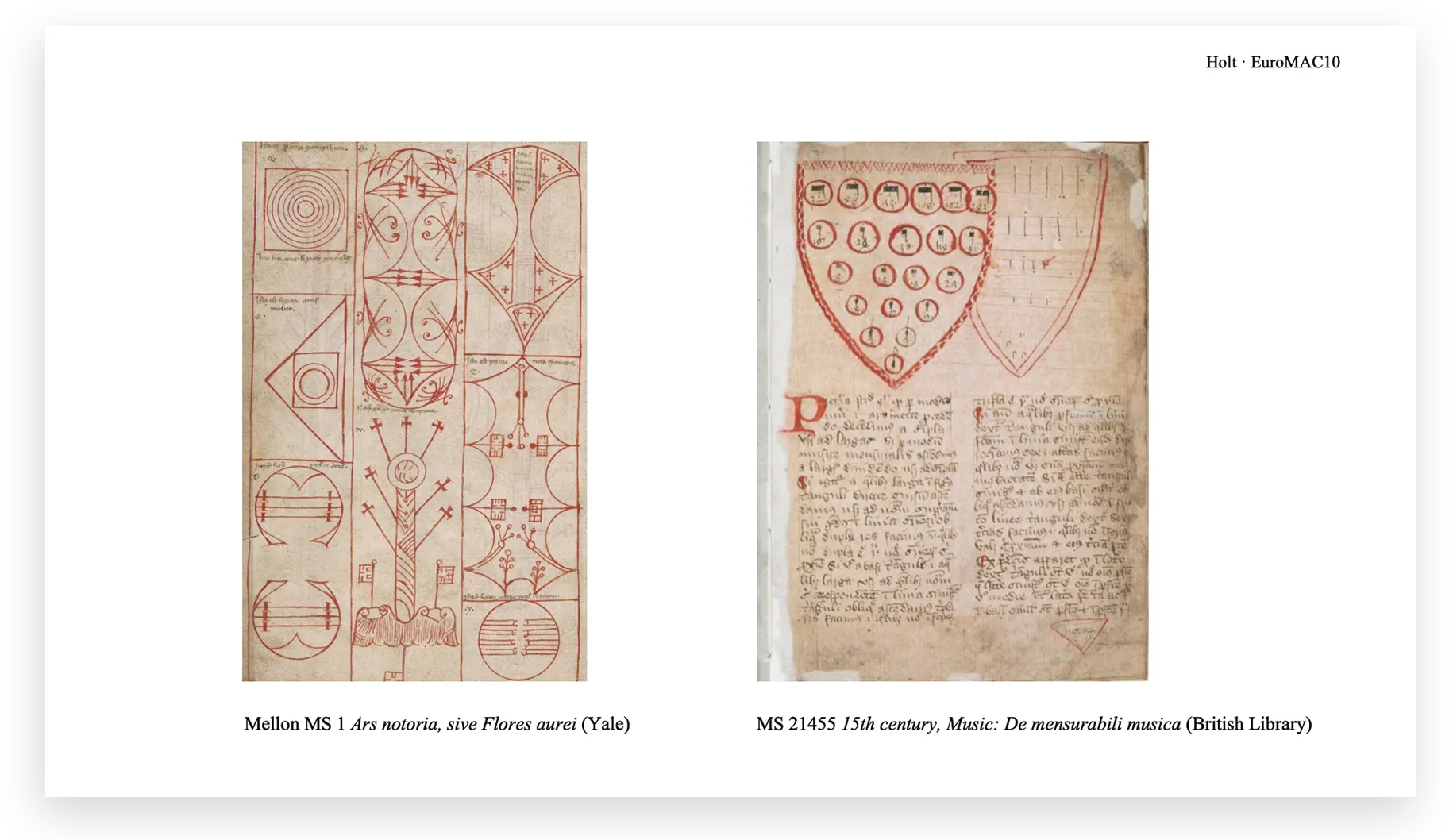
Considered in parallel, the subject of magic can augment our understanding of a medieval mindset that would have considered the nota to be not merely a transcription of sound but a symbolic representation of sacred content. As it moves us away from the institutions that controlled musical thought, it leads us to ask what is the purpose of music beyond the expression of prevailing concepts of the universal. To suggest then that the ars nova developed extra-institutionally is to apply a sharper focus on the autonomy and control that composers achieved via the technology of notation and exactly how this shifted the purpose and aims of music theory in the process.
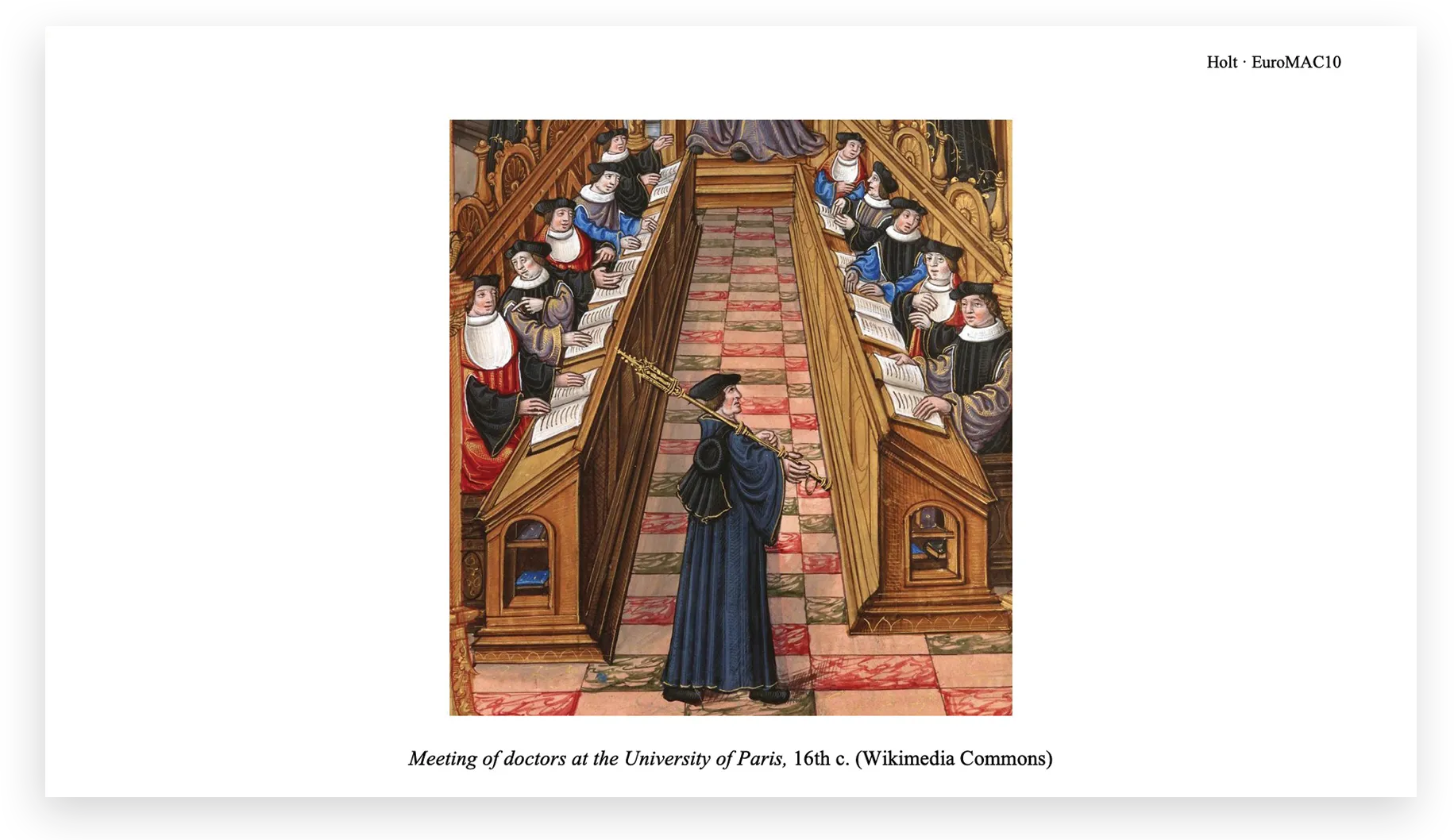
Joseph Dyer, in his study of the place of music as an academic subject in the University of Paris, begins by summarizing the Christian perspective on the liberal arts. These subjects “were not an end in themselves. Rather, they predisposed the mind and the heart to a more profound understanding of the Scriptures and sacred theology.” As one of the four Quadrivial arts, music was understood to be a foundational form of knowledge. However, the changing direction of the university toward natural science and empiricism left behind the Quadrivium and the dense, complex texts of Boethius, pushing musica speculativa to the fringes. Dyer’s investigation of the 13th century university leads him to the conclusion that if and when music arose as a subject of scholarly debate or examination, it was chiefly to question the relevance of the subject area to its curriculum at all. His review of exam questions on the subject of music finds that most would require no special knowledge of the subject or deep engagement with any concepts from musica speculativa. Generic prompts like “whether music is a scientia, whether it is a single scientia, what is its usefulness, and its proper subject” outline an institutional viewpoint that music’s intangible nature renders it irrelevant to the Aristotelian enterprise of observation, dissection, and cataloguing of one’s physical reality. Johannes de Muris’ Musica speculativa (ca. 1323) offers us another example. De Muris’ text was a gloss of a cornerstone Quadrivial work, Boethius’ De institutione musica, designed to be read in place of Boethius, keeping only what de Muris saw as important to formal university education. He focuses on a discussion of number and mathematics; he omits the philosophical subject of music mundana entirely. While university studies grew beyond the Quadrivium, Dyer finds no evidence to suggest that music as a discipline grew along with it.
This Aristotelian inclination bears out in the ars nova treatises attributed to Phillipe De Vitry. Save only a single reference to the Boethian musica mundana in the opening line of the Vatican manuscript, the writing is otherwise bereft of traditional conceptual concerns of virtue, beauty, propriety etc. John Douglas Gray finds, in the treatises of this time, a music “seen as something increasingly autonomous, no longer dependent on a cosmological framework for its existence” and musicians who are “attracted to exploring new musical parameters less for their theological ramifications than for their intrinsic aesthetic worth.” However, I would argue that these theological associations are an important aesthetic facet.
If we consider that the field of spiritual contemplation faded out of favor among the academic establishment, that’s not to say the lines between belief and empiricism were so clear cut. By 1402, engagement with magic at the University of Paris became pervasive to the point that its chancellor, Jean Gerson, published an official condemnation of magical practice. His On Errors Concerning the Magic Art makes direct reference to the use of “amulets, inscribed figures, spells that included strange or foreign-sounding words” among the university’s medical faculty. This highlights the integration of magic, science, practical knowledge, and divine belief, revealing to us that such magical things — drawn figures, inscriptions, incantations, etc. — as they align to writing, speaking, and observation are also the raw materials of scientific inquiry, deployed here toward solving the selfsame problems. Those in learned circles worked at the edge of what is known and knowable, employing extra-institutional knowledge systems as practical extensions of institutionalized learning.
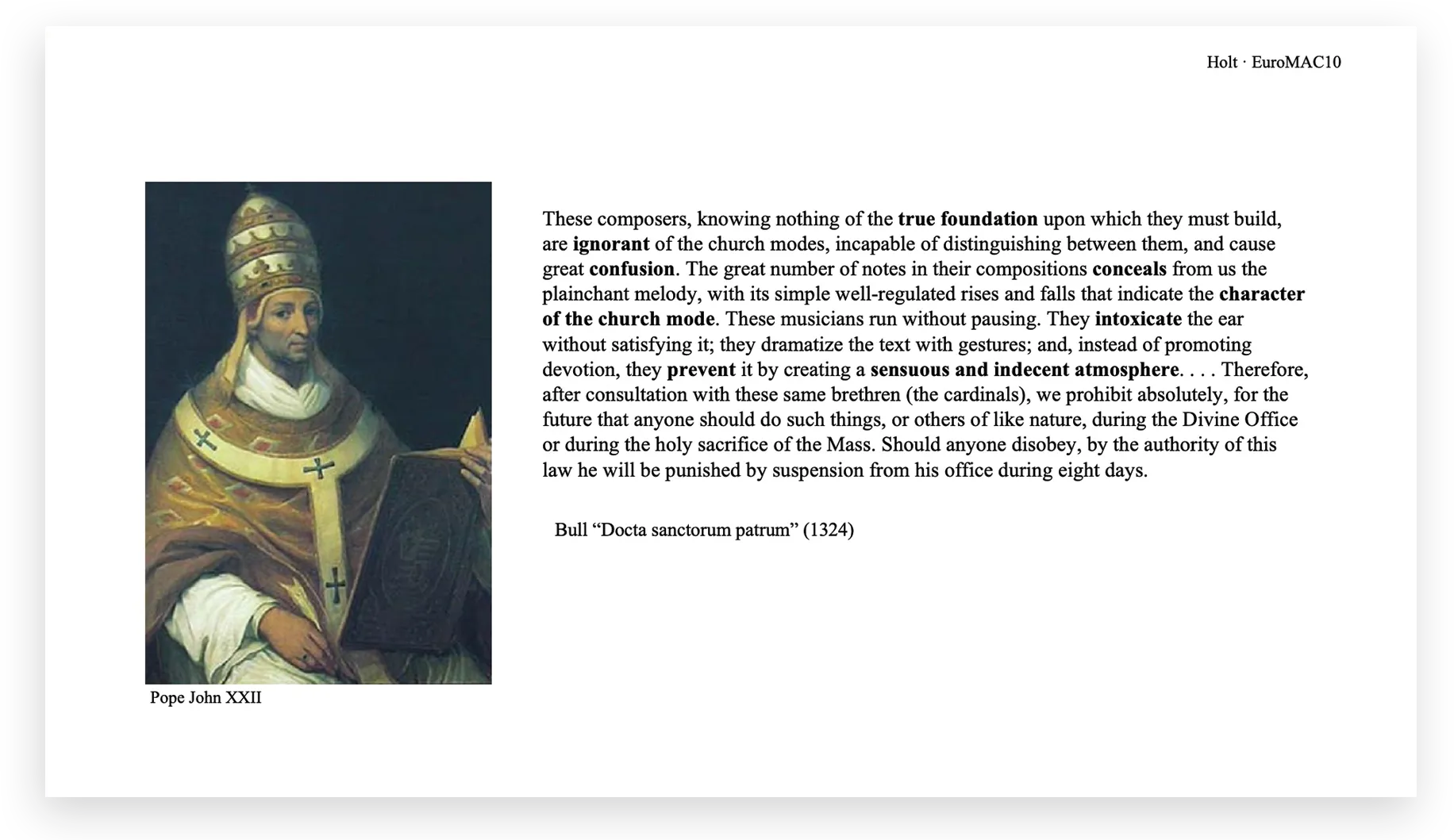
While de Muris’ truncated take on Boethius reflects the academic attitude toward the value of musica speculativa in the context of university education, the church levied its own concerns against the transgressions of the modern musica practica. In 1324, Pope John XXII issued a papal bull accusing the musica practica nova of a misuse of theory and an introduction of dangerous elements of invention, which abuse and degrade traditional melodies. A papal bull issued just two years later condemning magical practice suggests a growing tension between sanctioned and deviant activities, implying a flourishing of these activities. After the papal critique, we find the most pronounced opposition of the ars nova in the Speculum Musicae by Jacobus de Liège:
Oh, if only he had not named such monstrosities! … Oh, so much abuse, so much illegality, so much vanity … But if the ars nova spoke concerning these imperfections only in a speculative way, it would be more tolerable: but it is not so, for they excessively extend imperfection to practice.
George Harne tells us that “Jacobus judged that the moderni had confused the ends (or final causes) of musica speculativa and musica practica, a confusion which led — in his opinion — to the excesses and irrationality of the new art.” Jacobus here reveals what is at the heart of this divergence. Music theory and musical practice were never designed to meet, let alone that theory should be employed to justify practice. These musical formulations, and the impossible sounds they conjured, vandalized universal order the moment they permeated the boundary of theory to test the practical limits of the nota. It is the “theological ramifications” held within practical elements which pose the threat. For instance, the long — a note value comprised of three breves — represents the essential unity of the trinity. For the new art to view longs and breves as elements that could be added to one another, multiplied, subtracted, and otherwise manipulated at will, inverted the hierarchy by which music, and thus the world, was organized. Measured notation functions by larger notes acting as containers for smaller notes: that is, higher order elements are merely vessels for lower ones. As well, the new art’s impartiality to perfect and imperfect time are not removed from an ideology that holds the trinity as perfection. That steering musical practice could be an end goal of theory overcame theology: it is now the poet-composer for whom nothing is restricted.
The Ars Notoria insofar as it establishes another form of speculation united with practice, validates this inversion of hierarchy. It becomes clear when we reconcile the methodical tone of ars nova treatises with the polysemous nature of the motet, which grew from this new music theory, that the framework of Aristotelian experimentation provided critical tools for turning music into a form of self expression. But this doesn’t mean that musical autonomy was at odds with Platonism. That is what opens a path from the nota to the mundana. It is within this ideological mixture that musicians then came to define the ends of music theory and musical practice for themselves, beyond traditions within which music was always obsequious to other invisible orders, be it mathematical or celestial. Maintaining this connection while inverting it allowed an otherwise hermetic writing system access to universal poetics.
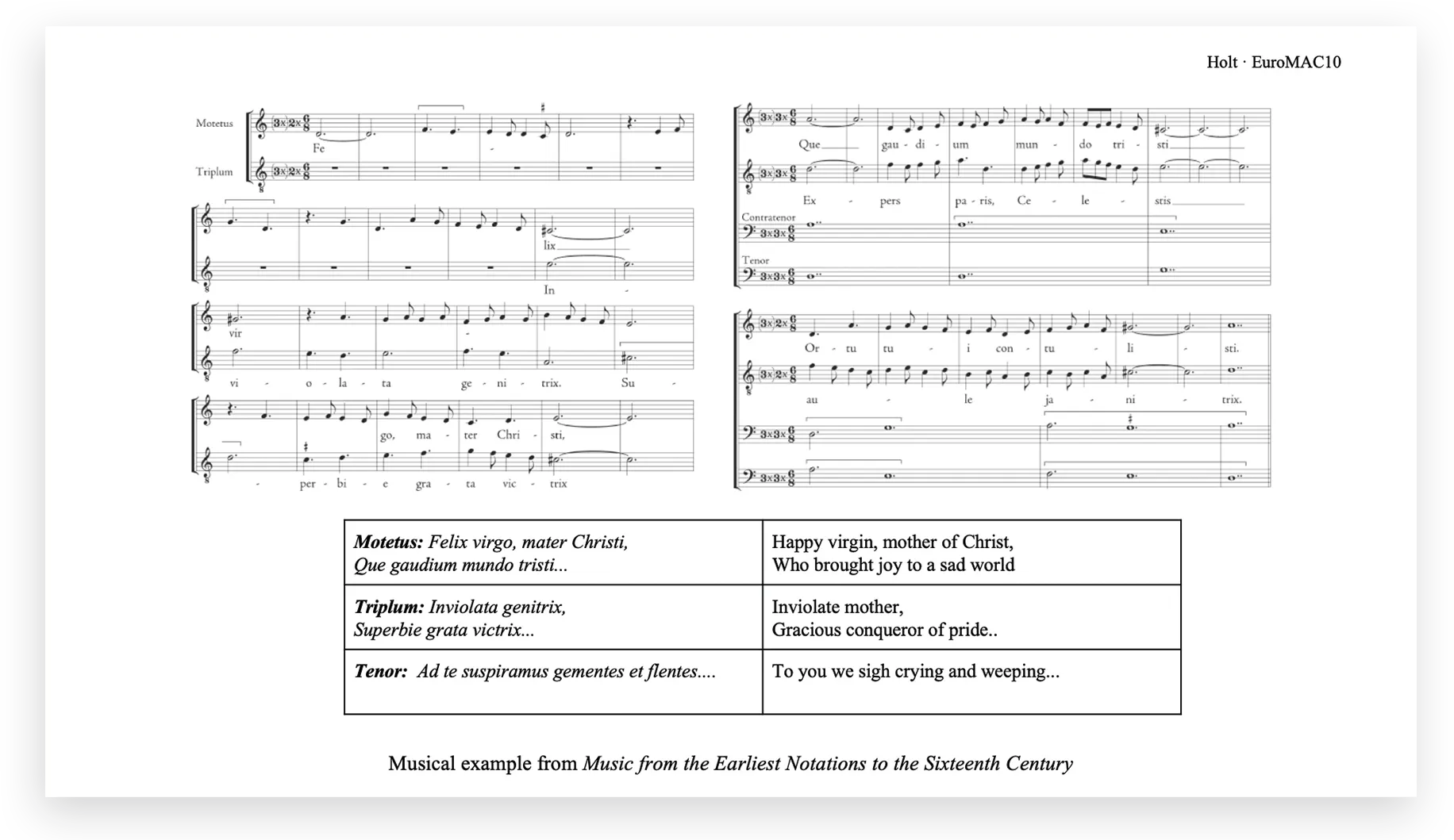
Richard Taruskin gives an account of the ars nova that brushes with the topic of magic and provides us an opening to apply this new perspective to problems of analysis. Chapter 8 of his Music from the Earliest Notations to the Sixteenth Century hints at certain occult underpinnings in the music of Guillaume de Machaut, though falls frustratingly short of exploring magic as an active influence on ars nova composers and theorists. Of one of Machaut’s final motets, Felix virgo/Inviolata genitrix/Ad Te Suspiramus, he says:
Although the diminution of note values in the talea is quite salient to the ear… the “polymetrical” superimposition and exchange of perfect and imperfect mensurations in the slow-moving lower parts is not. In this it resembles the harmonious orbits of heavenly bodies, which fit together according to the divinely ordained music mundana, and which according to ancient tradition emit tones that the mind can infer, but that the senses cannot experience. Like the architectural analogy, this analogy too was surely present to the composer’s imagination as he planned the trajectories of his supporting voices. It reflected the neo-Platonic worldview of every master of science or magus (the word, not coincidentally, from which “magician” is derived).
But a “neo-Platonic worldview” tells only part of the story. The poet-magician’s work is motivated by an impulse to constantly reconcile the world as measurable/sensible and immeasurable. To the extent Machaut himself wrestled with Platonic concepts, Sylvia Huot finds that “he continually reinvents and recasts the Boethian model, constructing his own vision of the relationships between love, desire, memory, and art.” For example, Machaut’s La Remede de Fortune diverges from its Boethian model precisely because Machaut never attempts to transcend beyond courtly love to spiritual love. That the milieu of Felix virgo/Inviolata genitrix suggests nothing of planetary song points to a restriction of Taruskin’s view of magic. Evident in this reference to astrological magic is a heavy reliance on Gary Tomlinson’s book, Music in Renaissance Magic. John Haines, whose work is prolific in the arena of medieval music and magic, takes specific issue with how Tomlinson’s book couches medieval magic, saying that “Tomlinson assumed a revival of magic in the 1500s from its near state of oblivion in the Middle Ages…This concept does not hold up to the historical evidence that presents us instead with a continuous tradition of magic from antiquity on,” which would explain why magic in the above passage is invoked as an aside and its influence is of a passive nature.
Machaut’s magic is of a different kind, much more akin to Orpheus’s song. As Machaut explores the myth in Le Confort d’Ami, Sylvia Huot says:
Machaut stresses the success of Orpheus’s song, motivated by hope and also, of course, grounded in the memory of Eurydice. Poetry and music, according to Machaut can conjure up an alternative reality; they can make memories real.
With a clearer picture of the sympathetic connection between music and learned magic of the time, we might re-draw Taruskin’s conclusion that the isorhythmic motet was preoccupied with “a representation of the higher ‘intellectual’ elements” that are “hidden from the senses.” His characterization of Machaut “the magician,” defers again to Tomlinson’s book, claiming that the composer believed — quoting Tomlinson now — that “the world was hierarchically ordered…that superior elements in the hierarchy influenced inferior ones.” What is missing in this formulation is how a composer gains this heavenly access to reap its benefits. The Ars Notoria posits an answer, which amounts to an overturn of the control of the hierarchy itself, establishing what Julien Véronèse describes as “a true relation of domination” on the part of magician.
In fact, it is the work of the lower orders that Taruskin cites as evidence of the higher intellectual elements. In this formal analysis he is quite conventional. At various points he observes the sensuousness of the motet, the mechanics of the talea and color, along with — as we’ve seen — references to the invisible order of musica mundana in its architecture, and we fill in the blanks between assuming all these techniques in aggregate result in musical meaning. It would be in bad faith to attempt to correct any of these points on their own, we mean only to understand how the worldview of the poet-composer is not a conflict between opposites — sacred and secular, rational and irrational, and so on — but a cohesive whole.
Viewing the motet architecturally misses a critical opportunity to probe its purpose. What happens if we attribute a magical purpose to the motet: one that directs the divine toward earthly problems by way of a transformative textual, sensuous, and abstract experience via music? This goal of contemplation, which manifests and makes real via the image, is in line with poetic goals of a composer like Guillaume de Machaut.
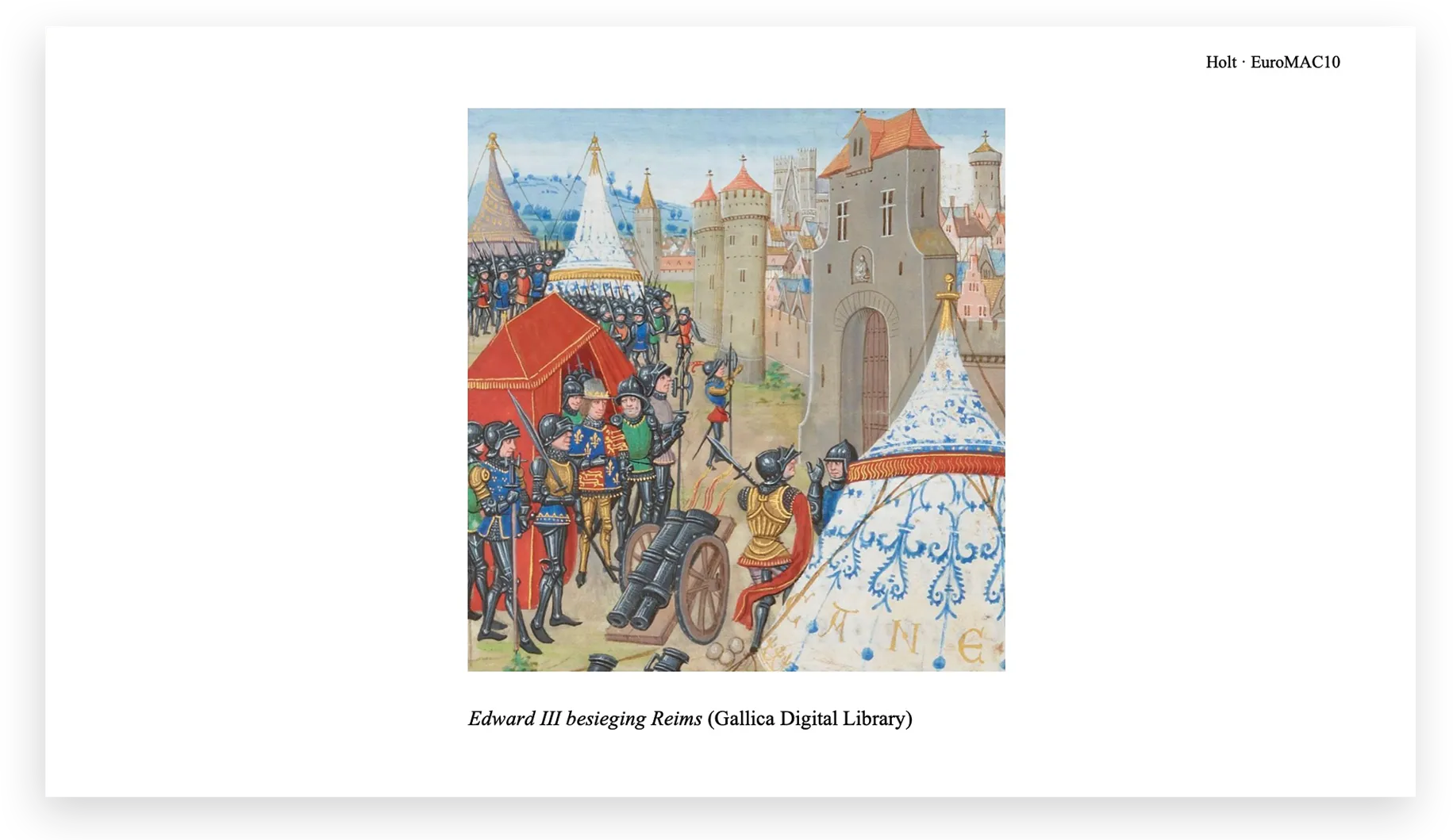
The motet was likely written just after the Siege of Reims. In its triple-invocation of Mary, Felix virgo/inviolata, the piece is less an architectural semblance or Platonic thread to celestial bodies than contemplation on the image of Mary as a remedy for despair. Our glance at the Ars Notoria opens up a wealth of meanings that extend in this direction: to bring Mary to us for consolation and protection, to make indelible the memory of Siege. The piece itself could be an aide-mémoire, an image itself, or its function could be more visionary in nature.
For Machaut, music is a remedy, remede, a medicine for the emotions, and the motet delivers Mary to heal us. The composer has no incentive to break the platonic connection between the human and the divine, but to maintain an unrestricted access to all expression. The sensuous texture of the motet, the surface expression of its rigorous order, exposes the secret control and agency of the composer for all to hear. The composer actively elicits the image not by adding on top of the chant but by filling the vessel of the chant voice with notes and words.
What is the most compelling endorsement of an esoteric reading of ars nova is that by the same impulse — the desire to locate the modus operandi of the ars nova — we can arrive at such opposite interpretations of its magical effect. This speaks to the great mystery of the medieval mind, which held such contradictions and conflicting concepts of the sacred and profane in a special balance.
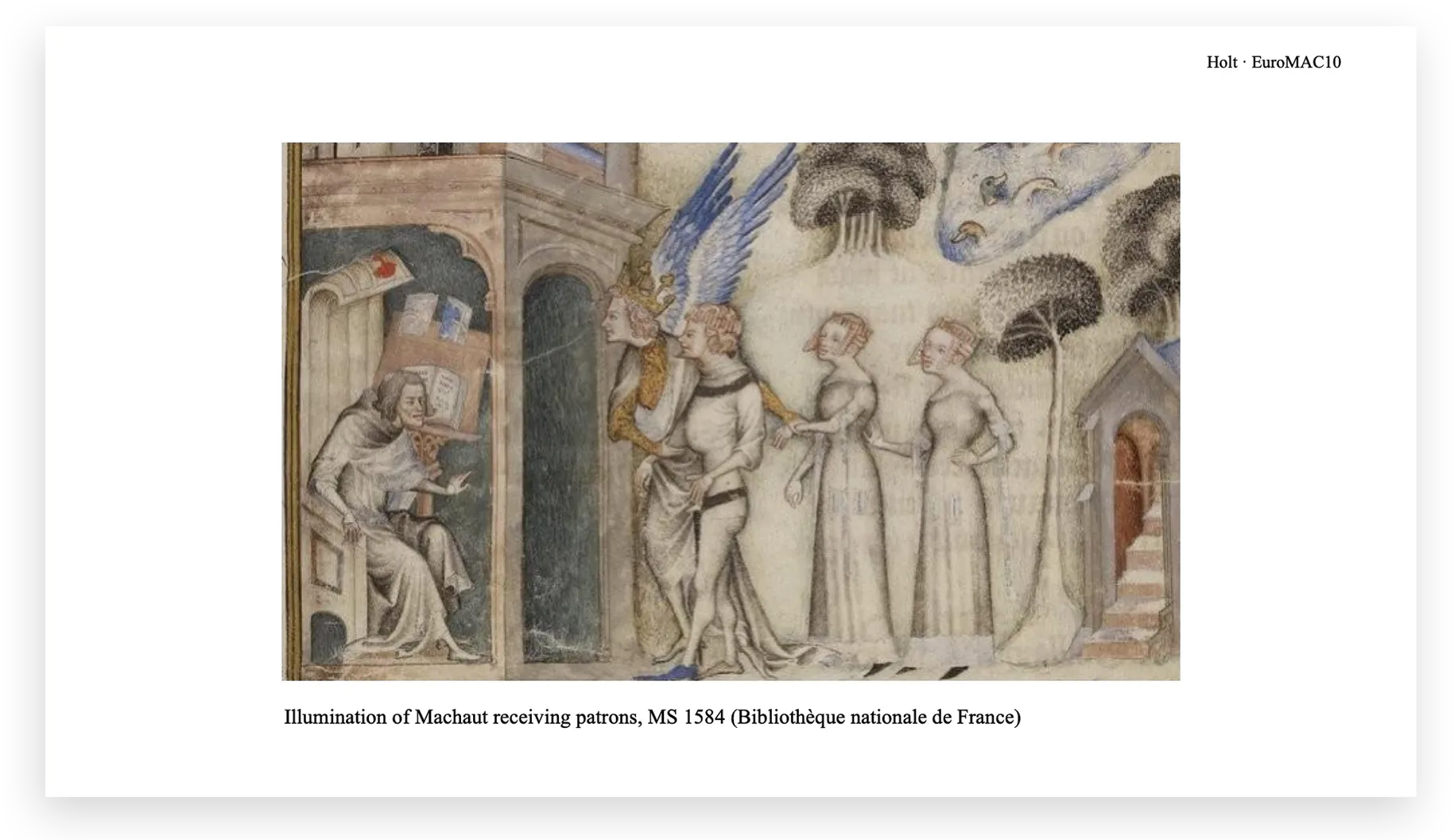
The union of music theory and musical practice was not a victory of the secular over the sacred, nor was the motet a neoplatonic relic swept up in an intellectual current of Aristotelian empiricism. The Ars Nova and Ars Notoria both preserved the structure of human-divine connection but inverted the relationships. In the illumination which introduces his collected works, Machaut makes explicit an image of dominion and deference. His patrons come to him as he sits in his dark world.
If musical knowledge becomes the end goal of music theory, then what larger ideology does it really serve? Theory may then only describe the architecture which surrounds practice. Our intention here is to show that similar operations in music cannot be located in (or in fact run counter to) either the university or church thought, and that magical learning may reflect certain emancipatory conditions for the ars nova movement as it developed unrestricted to those traditions. What is more, the music and magic comparison removes us from parallels which assume a power dynamic within which music always maintains a deferential position: say, to the functional nature of academic knowledge or to the orthodoxy of church doctrine.
We call this simply a “reading” because it is just one of many threads to follow. Perhaps what these ideas affect most is the mindset with which we approach analysis. We find similar entanglements around music’s true nature and purpose in Rameau’s le corps sonore, which was both a generative practical theory of music and a spiritual one, and there are perhaps traces of the same in Boulez’s black box of integral serialism, a deviant application of theory. As a composer, I have a personal stake in exploring the advances of the art that are extra-institutional. Understanding patterns of knowledge transmission that cooperated with or challenged existing power structures is as pertinent and timely an inquiry as there could be.
Jacobus tells us that the proper goal of music is to soothe and judged “that the new art had developed in a way that was contrary to the aesthetic limits and norms of human sensory and intellective cognition.” Perhaps we can conclude from this that the uniting speculativa and practica is not at odds with Jacobus, but that it soothes in the case of the new art by stimulating the intellect, by giving agency to the composer and transferring that agency to the listener via its conjured images, by giving voice to what is hidden, by rupturing the secrets of music.
References
- Bailey, Michael D. “A Late-Medieval Crisis of Superstition?” Speculum 84, 2009.
- Bailey, Michael D. Fearful Spirits, Reasoned Follies: The Boundaries of Superstition in Late Medieval Europe. Ithaca: Cornell University Press, 2013.
- Dyer, Joseph. “Speculative ‘Musica’ and the Medieval University of Paris.” Music & Letters 90, No. 2 (2009).
- Earp, Lawrence. Guillaume de Machaut: A Guide to Research (Garland Composer Resource Manuals). New York and London: Garland Publishing, 1995.
- Fanger, Claire. “Christian Ritual Magic in the Middle Ages.” History Compass 11, no. 8 (August 2013): 610-618.
- Forshaw, Peter J. “The Occult Middle Ages.” In The Occult World. Edited by Christopher Partridge. Routledge: London, 2014.
- Fuller, Sarah. “A Phantom Treatise of the Fourteenth Century? The Ars Nova.” The Journal of Musicology 4, No. 1 (Winter 1985-86).
- Gray, John Douglas. “The Ars Nova Treatises Attributed to Philippe de Vitry: Translations and Commentary.” Ph.D. dissertation, University of Colorado, 1996.
- Haines, John. “Why Music and Magic in the Middle Ages?” Magic, Ritual, and Witchcraft 5, no 2 (2010): 149-172.
- Harne, George A. “The Ends of Theory and Practice in the ‘Speculum Musicae’.” Musica Disciplina Vol 55 (2010): 5-31.
- Taruskin, Richard. “Business, Math, Politics, and Paradise: The Ars Nova.” In Music from the Earliest Notations to the Sixteenth Century. Oxford: Oxford University Press, 2005.
Sources
Ars Nova Manuscripts
- Vatican Library, LAT 307
- Paris, Bibliothèque nationale, fonds latin 14741 (F-Pn 14741)
- Paris, Bibliothèque nationale, fonds latin 7378A (F-Pn 7378A)
- London, British Library, Additional 21455 (GB-Lbl 21455)
Ars Notoria Manuscripts
Images
More essays
- I watched 10 Masterclass courses in a week and here is what I learned August 26, 2021
- Poetics of the Fragment Conference June 19, 2021
- Here's a hammer for your thesis statement December 15, 2020
- The Utopian Syllabus August 1, 2019